
I promised myself not to write too often, but after the Citrini report I couldn’t resist. And perhaps the fact that people with no background in software engineering have started reaching out to tell me how convinced they are that coding is over had something to do with it as well.
Before I tell you what I think is actually happening, I need to give you some context.
What I saw
I just returned from a visit to Linköping University, where I had the honor of getting a tour of their EIT department; Electrical Engineering, Information Technology, and Computer Science. Walking through the corridors, I was reminded of the people working at my own alma mater, LTH at Lund University. Doctorants, professors, researchers - almost all with non-Swedish sounding names. Iranian, Indian, Chinese, Eastern European. Andersson? Maybe one. Same pattern in Linköping. And where the names did sound ethnically Swedish, they were mostly older professors approaching retirement.
This pattern is not limited to Sweden. A couple of years ago I visited UCLA and saw the same thing. They actually had a catalogue of class photos stretching back to the 1970s. Forty years ago, every face was unmistakably light-skinned. Today, nearly everyone has dark hair. I also remember watching a mathematics documentary featuring a professor at the Courant Institute; New York University’s applied mathematics department, considered one of the best in the world, where the professor himself mentioned that he only had Asian students. No white Americans.
And this isn’t limited to academia. Google’s CEO: Sundar Pichai. Microsoft’s CEO: Satya Nadella. Perplexity’s founder: Aravind Srinivas. The OpenAI team that actually built the models consisted almost exclusively of Poles, several of whom are considered among the best in the world at AI research. Ilya Sutskever, one of the core founders, is Russian-Israeli.
Why are we here?
To understand the current situation, we have to strip away the fluffy semantics and look at reality itself.
After wars, societies are naturally in close contact with physics. We need to rebuild houses, roads, infrastructure, and companies. That requires STEM skills. I label this a low entropy state because everything we do and plan has a direct connection to something physical. There are no ten layers of middle management and paperwork. It simply doesn’t make thermodynamic sense.
This produces what I would call real jobs. Engineering and manufacturing become the primary engines of growth. Technology drives innovation, which produces more wealth. I call these gradients - currents, or waves, that others can ride and create wealth from.
If you haven’t guessed it already: AI is such a gradient. It’s a wave everyone wants to ride because there aren’t many of them in our part of the world today. And the reason there aren’t ties directly to the corridors of Linköping and LTH; there are very few people born in the West who actually know how to build things.
This is not a moral critique. In fact, it makes rational sense to move to the coordination layer, because once a society is rebuilt, the gradients propagate upward. A clear example: electricity becomes commoditized, computers are built on top of that infrastructure, which creates new markets for software, then internet, then social media, and so on. The same happens in municipal administration, legal, finance, and every other domain. The higher up we go, the higher the entropy gets.
The pattern
Historically, this has been the most predictable pattern of how societies evolve. Many philosophers have written about it. One of them is René Girard, whose work on mimetic desire I’ve discussed before. There are also popular memes circulating that say something like: strong men create good times, good times create weak men, weak men create bad times, bad times create strong men.
A more precise phrasing, and my personal one: low entropy goes to high entropy and then compresses back to low entropy. Repeat.
The mechanism is simple. Just like all thermodynamic systems we can observe, we follow the energy. When it makes rational sense to not study hard STEM subjects but finance, law, or gender studies instead, what that really means is that we are responding to social pressure, feelings, and what we believe would make the world a better place. But it runs deeper: prosperity - the affordance to be in a higher entropy state - removes the necessary pressure to force oneself toward low entropy. Building, engineering, and STEM are inherently low entropy activities. They require hard and sustained effort. It is simply unlikely that most of us will choose them unless external circumstances force us to.
The football pitch
Since we live in the age of AI, and everyone assumes people are spending too much time trying to find the meaning of life by chatting with AI bots, let me tell you what actually initiated this whole way of thinking:
A couple of years ago, I found a book by Professor Jonas Frykman, an ethnologist at Lund University, called En ljusnande framtid. It caught my attention because the professor’s thesis was that upward mobility in Sweden has completely vanished - and since my own life story is entirely about upward mobility, I needed to read it.
The line that captivated me was when Frykman compared today’s schooling to the time when he was a child. Imagine a football pitch: you have two goals, perpendicular lines, the penalty areas, one line in the middle, and the rectangle spanning the entire field. You have two teams, specific colors for each, and the rules are simple: pass the ball to players in the same jersey, and score as many goals as possible. That, according to Frykman, is how school worked when he was young.
Now imagine the same pitch but with lines randomly drawn everywhere. One goal smaller than the other, perhaps even tilted away from the field. Mixed colors for each player, and everyone can pass to everyone. That is today’s school.
His core thesis is that Sweden has moved from what ethnologists call structure - clear boundaries, clear rules - to communitas, which is what we usually have with family members: fewer rules, more fluidity. But this shift has happened inside the schooling system. It has created apathy, for reasons that should be obvious to anyone who has ever played a sport in their life. Which football game would you rather play?
Now swap structure for low entropy and communitas for high entropy, and you’ll notice the pattern.
Everything in life follows the energy. The forces that keep us away from STEM are extremely strong. We are drawn into the gradients because the whole society pushes us in that direction. We mimic what others do, because others are following the energy as well. This is where it becomes really interesting, because Girard’s theory is entirely about mimicry; his core thesis is that we imitate each other’s desires. Now you know why.
This works as long as there is enough energy for the system to maintain itself. But here is what eventually happens: the channel gets so deep - layers of coordination, middle management, process overhead - that any fluctuations in the energy source start to rumble the whole system. This is what we call scarcity. And this is where Girard says conflict happens: precisely because energy is losing momentum, which makes participants less predictable, since we now have to act. Our actions increase the heat - energy can no longer flow optimally - which eventually requires a heat sink, or as Girard would put it, a scapegoat. Historically, the most effective heat sinks have been wars, unfortunately.
Back to AI
Now that you have the necessary context, I can tell you why everyone in the West talks about AI the way we do.
AI is a multiplier. I know this because I’m a software engineer who has built systems end-to-end for many years. I use Codex, Claude, and Antigravity almost daily.
But there is even better evidence: radiologists. I’ll admit - I was convinced they would be out of jobs, because of all the things one could automate, analyzing static images seemed like the simplest. But it turned out that we have more radiologists than ever before. The technology made them better, not redundant.
The same goes for software engineering. I can now zoom out and focus on things I couldn’t afford to do before - infrastructure, security, architecture - things that are extremely important as threats continue rising year over year. The expectations for every application have risen tremendously. And take it from someone who managed to get Apple editorial recognition, entirely alone, in a world where most serious apps are built by teams. That is a very rare achievement: fewer than 1% of submissions - which should give you a sense of how deeply ingrained in software engineering and building I actually am.
My take is that the AI mania in the West stems from a deeper wish: that we will never have to go back to those corridors in Linköping and LTH. That we will never again have to fill those math classrooms. It is America’s wishful thinking that China’s superior manufacturing base won’t matter, because the US will lead in AI and that will bring unlimited wealth forever.
But here is the problem: AI is a multiplier, and China actually has real things to multiply: their manufacturing base. In the West, the only thing we can “multiply” - and I put it in quotes because in my experience most middle managers are redundant even pre-AI - is the coordination layer and some software engineering. Which is why, naturally, the entire coordination layer wishes software engineering to be fully automated away.
If this hasn’t convinced you yet: the company behind the Kungfu humanoid robots is valued at a third of what the homepage generator Lovable is. An equivalent “app” generator created by a single Israeli developer, Base44, sold for $80M and is by all reviews I can find equivalent to or better than Lovable. And in case you’re wondering what Lovable does with all their money: well, wonder no more:
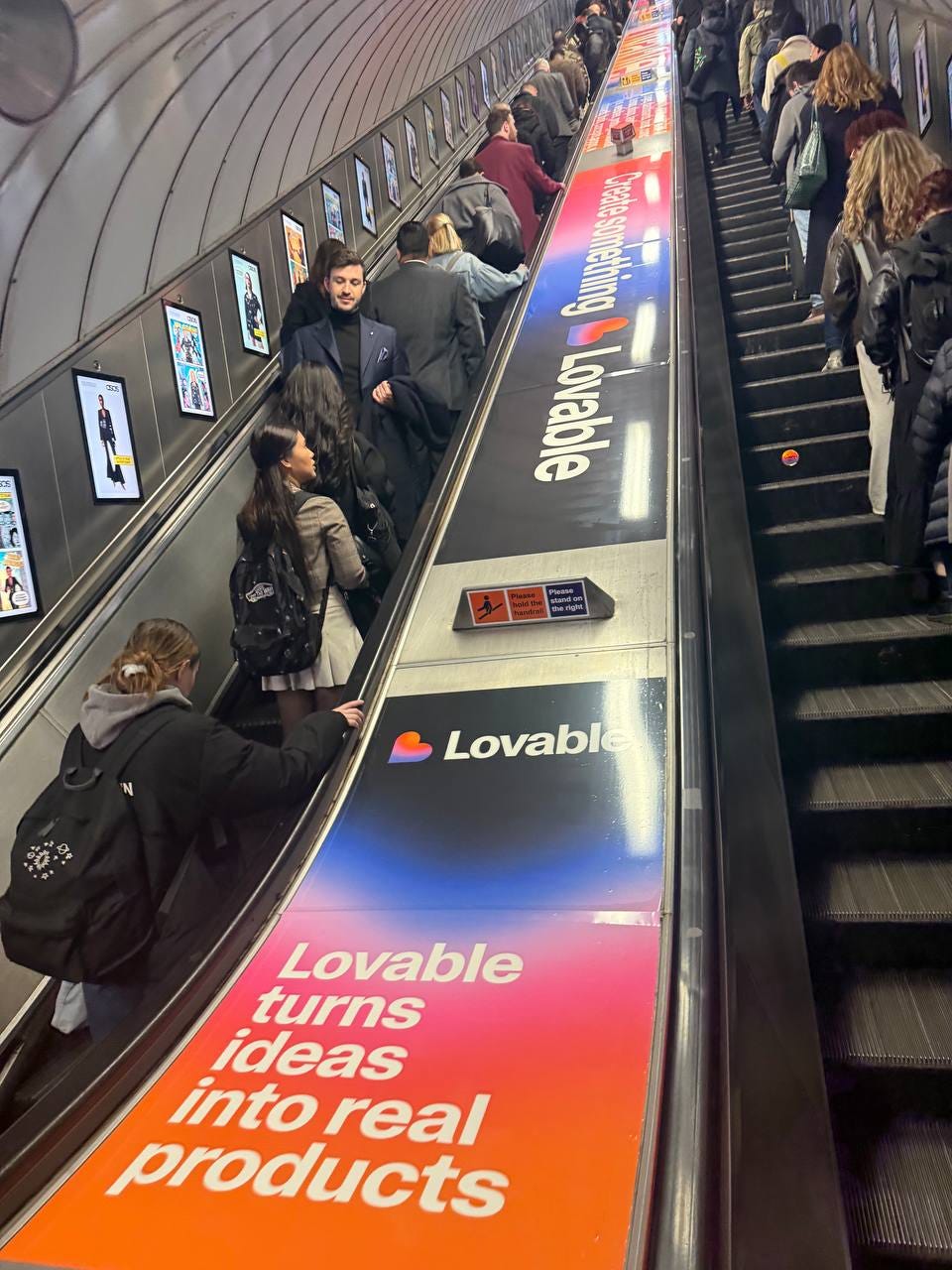
Taken from London’s subway. Thank you, Aleks.
The entire London metro, papered with ads for a company that wraps an API in a user interface. That is capital being converted directly into heat (read waste).
Conclusion
We have a compression ahead of us. It is not uncommon historically that high entropy periods result in decadence, miscommunication, and misunderstanding of reality. In fact, it has been precisely the reason wars have started. Now, it’s not certain we will end up there; some would argue it is highly unlikely because of our aging demographics. But the alternative is not necessarily better: a slow and steady decline until we become so diminished that we would have to start over, much like China did after the Second World War.
I believe one thing is certain: AI is not going to turn into AGI anytime soon, and the wishful thinking of the coordination layer will be in vain. Instead, I would urge all the dreamers to start studying math and physics, because Linköping, Lund, and the whole of society will need that. Badly.