
Nvidia just hit numbers on their quarterly report they couldn’t believe themselves. $68.1 billion in revenue, up 73% year-over-year, $78 billion guided for next quarter. The stock dropped 5.5% the next day. $260 billion in market value, gone.
The very same day, SoftBank, Amazon and Nvidia announced $110 billion in funding into OpenAI. $30 billion of that from Nvidia itself.
This might all sound crazy but it’s really not. Let me state it in my usual way: it’s just pure thermodynamics.
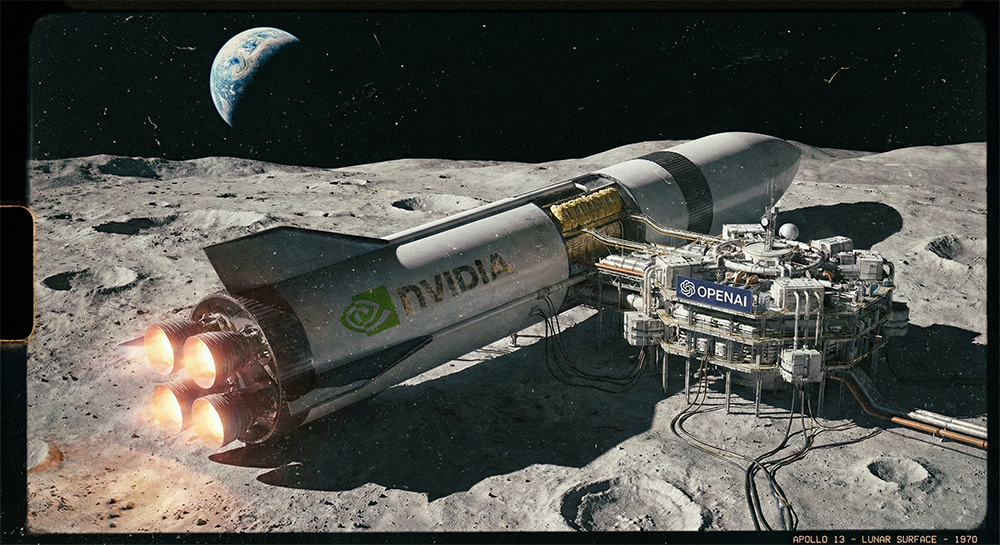
The context
Some people predict competitors like AMD and Google will begin intruding on Nvidia’s market share but this is highly unlikely considering recent figures. Most analysts agree that Nvidia’s moat is extensive, not only in terms of GPUs but their entire ecosystem; CUDA, networking, software stack, developer tooling. The whole thing.
But here’s what matters more. Jensen Huang is the longest-sitting CEO in Silicon Valley and has built a company whose culture is just like none other. Their Glassdoor rating is 4.5 out of thousands of votes, 91% say they’d recommend working there to a friend, 97% approval rating of Jensen himself. That puts the company in the top 3 of all organizations in the entire Glassdoor catalogue. On top of that, figures circulate that around 80% of their workforce are now de facto millionaires.
The dynamics
So it’s not only about the technology itself but perhaps more importantly the cultural aspect as well as the financial figures. Nvidia is what I would call unbelievably good at producing value. Jensen has simply built a juggernaut that is unrivalled to other companies not only in its market sector but vis-a-vis literally every single company on earth.
And that’s precisely the problem. Nvidia is executing so flawlessly that it’s breaking the physical limits of its own customers.
Let me give you the logic. Nvidia’s superiority in how efficiently and quickly they produce value for their customers puts enormous strain and pressure on other organizations that now struggle to match their pace. A simple example is one of the largest ambassadors for the company; OpenAI, that despite its remarkable user growth and 900 million weekly active users struggles to cover its extensive losses. Without further investment the company might not even survive. But that death is a direct hit on Nvidia’s bottom line.
Now look at the numbers again. Nvidia made $68.1 billion last quarter. The same week they had to put $30 billion back into OpenAI just to keep the ecosystem alive. That’s not an investment in the traditional sense. That’s a company so powerful it has to subsidize its own demand. Nvidia is basically becoming a central bank of the AI economy.
Which is exactly why Jensen keeps investing in companies that at first glance seem unrelated to their business model. He is aware of the dynamics and knows that’s the only way his own company is going to survive. Their customers must survive. OpenAI HAS to survive. It’s just like the food chain. If everything dies, so will Nvidia.
That $110 billion OpenAI round isn’t irrational. It’s life support for the ecosystem that justifies Nvidia’s revenue. The stock isn’t falling because the numbers are bad. It’s falling because the market is starting to sense what the numbers don’t show: the organisms that consume Nvidia’s output are not self-sustaining. They need constant infusion of external capital just to stay alive.
In thermodynamic terms; Nvidia is a heat engine of extraordinary efficiency. But a heat engine doesn’t just need a hot source, it needs a cold sink. If the downstream can’t absorb and convert the energy into useful work, into actual profitable businesses, the system stalls. Doesn’t matter how powerful the engine is.
The question isn’t whether Nvidia can keep building better chips. It’s whether anyone downstream can turn those chips into businesses that survive without perpetual subsidy. That’s the food chain problem. And right now, nobody has a convincing answer.